Dr. Sarah Waheed is a cultural historian of South Asia, specializing in pre-modern Persianate courts, modern secularism, and Muslim female sovereignty across the India-Pakistan divide.
Her fresh trade history book, Chand Bibi: The Lives and Legends of a Warrior Queen, recovers the forgotten story of the 16th-century Deccan queen who defended Ahmadnagar Fort against Mughal imperial armies—and explores how legends of female power survive in collective memory.
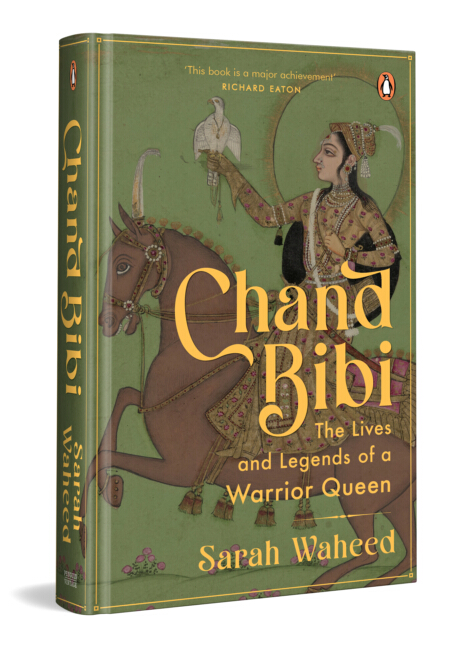
Available for pre-order across major South Asian & global retailers.
Assistant Professor of History, McCausland College of Arts and Sciences, University of South Carolina
Sarah Waheed is a specialist of South Asian history, teaching medieval, early modern, and modern South Asian history. She is a cultural historian who specializes in South Asian Islam in global and local contexts across the India-Pakistan divide. Her approach to the past is transregional and comparative, speaking to critical issues of religion and secularism, colonialism and nationalism, and gender and memory.
She received her Ph.D. from Tufts University in 2011, her M.A. from the University of Chicago, and her B.A. from Bryn Mawr College. She has been the recipient of prestigious fellowships, including a Mellon Foundation Dissertation Research Fellowship by the Council on Library and Information Resources (CLIR) and a Fulbright Scholar award for field research in the Deccan.
At the University of South Carolina, she teaches introductory and advanced courses on South Asian history, the Indian Ocean world, and the Partition of India.
Monographs spanning colonial literary culture and pre-modern Deccan sovereignty.
In 1595, Chand Bibi (1550–1600) of the Deccan sultanates in southern India defeated the most powerful forces of her time: the Mughal imperial armies of Emperor Akbar. By turning to the Deccan region, this monograph challenges the north-centric perspective of Mughal imperial development and problematizes modern ideas of Muslim women existing only on the margins.
A ground-breaking examination of the cultural politics of the Left in late colonial India and the Pakistan movement. The book demonstrates how progressive Muslim intellectuals engaged with socialism and communism through their distinctive ethical and literary past, complicating conventional binaries between 'religion' and 'the secular'.
Recent popular writings, podcast features, and visual art critiques.
An essay exploring 18th-century Deccan paintings, falconry iconography, and the pluralistic political landscape of Ahmadnagar and Bijapur.
Read Overview →An art historical analysis of miniature paintings depicting Chand Bibi on horseback alongside her female armed retinue, the Urdubegis.
Read Overview →Audio feature discussing Chand Bibi's military campaigns, the legends of her death, and how historians separate myth from archival records.
Listen & Media Links →